

Audit Criteria
Audit Criteria are the controlled set of requirements — norm clauses (e.g. ISO 9001 chapters) or internal procedures — that audits and findings are assessed against. This gives you a structured, reusable requirements catalog instead of free-text references.
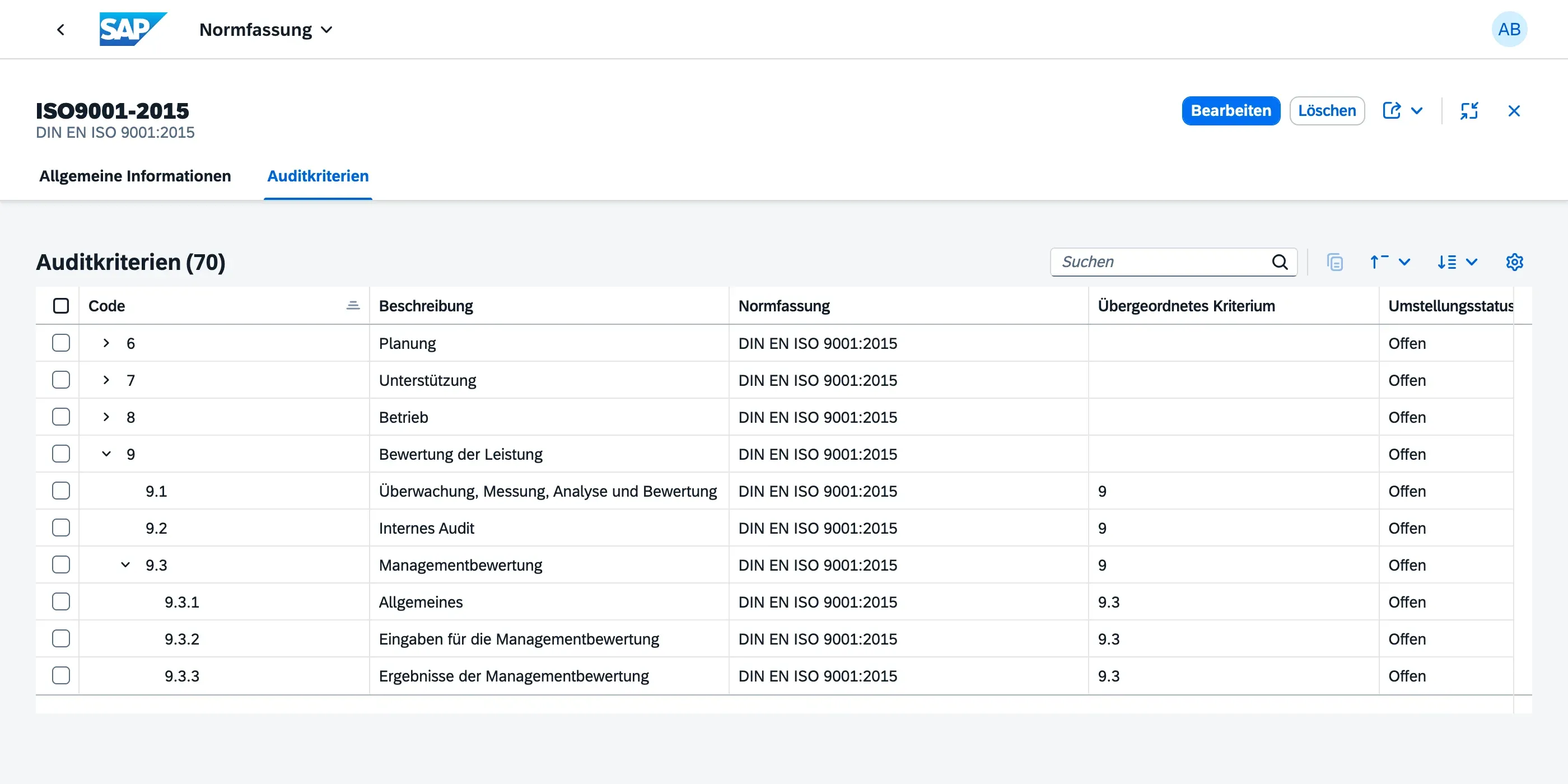
Structure
Section titled “Structure”Audit Criteria are hierarchical, similar to Org Units: a criterion can have a parent, allowing you to model a chapter structure up to three levels deep — for example 9 → 9.3 → 9.3.1.
Each audit criterion has:
| Field | Description |
|---|---|
| Code | The clause or reference number (e.g. 9.3.1) |
| Description | What the clause covers |
| Norm Standard | The norm edition this criterion belongs to (e.g. “ISO 9001:2015”) — a reference to the Norm Standards master data, not free text. Always set: internal procedures that aren’t tied to a published standard use a seeded “Internal” edition rather than leaving this empty |
| Note | Optional organization-specific context, e.g. how or how often this criterion is assessed internally |
| Parent | The higher-level criterion this one belongs to, if any |
| No Counterpart in Paired Edition | Confirms this criterion deliberately has no match in the paired standard’s edition (no successor if this is the old edition, no predecessor if this is the new one) — see Norm Standards |
Where Audit Criteria are used
Section titled “Where Audit Criteria are used”- Questions in a Question Catalog can optionally reference a single Audit Criteria entry — see Question Catalogs
- Findings are pre-filled with the Audit Criteria from the question they were raised against, but this can still be changed — see Creating & Classifying Findings
- Every Audit is assessed against exactly one norm edition (Applied Standard) — see Audits
Managing Audit Criteria
Section titled “Managing Audit Criteria”Audit Criteria are maintained by your Master Data Admin, in the Norm Standards maintenance app — as a criteria tree underneath the relevant Norm Standard. Because the hierarchy is used to pre-fill findings and drive reporting, plan the chapter structure carefully before rolling it out broadly.
Norm edition changeover: mapping old criteria to new
Section titled “Norm edition changeover: mapping old criteria to new”When a standard is revised (e.g. ISO 9001:2015 → ISO 9001:2026), create the new criteria as their own tree under the new Norm Standard — the history of the old edition stays untouched. See Norm Standards for how to work through the mapping using the changeover workbench, and how to carry a question catalog’s criteria references forward to the new edition.
Next Steps
Section titled “Next Steps”- Norm Standards — create norm editions and manage their criteria trees
- Question Catalogs — link questions to Audit Criteria
- Creating & Classifying Findings — how criteria pre-fill onto findings