

Analysis Lifecycle
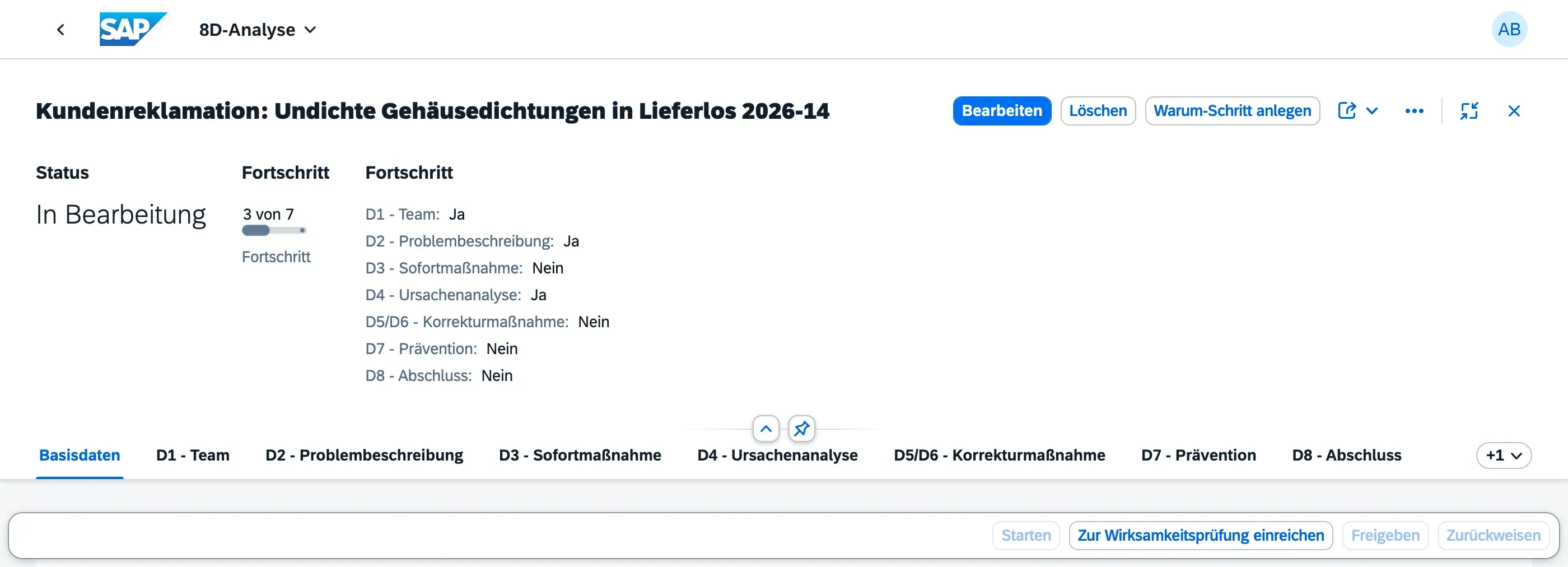
Every root cause analysis — 5-Why or 8D — follows the same four-status lifecycle. Move it forward with the buttons at the bottom of the analysis; only the button for the next valid step is available.
| Status | Meaning | Action to move forward |
|---|---|---|
| Draft | Created, not yet being worked on | Start → In Progress |
| In Progress | The analysis is being worked on | Submit for Verification → Pending Verification |
| Pending Verification | Submitted; effectiveness is being reviewed | Approve → Completed, or Reject → back to In Progress |
| Completed | Approved and signed off (terminal) | — |
Why there is a verification step
Section titled “Why there is a verification step”An analysis that can be closed by the person who wrote it proves nothing. The Pending Verification status is the gate: the working team submits, and a Root Cause Manager decides whether the causes are plausible and the measures actually worked.
Approve closes the analysis and records the signature — who approved it and on what date — in the closure section (D8 in an 8D analysis). Reject sends it back to In Progress; record what is missing in the verification note so the team knows what to fix.
Both actions are restricted to the Root Cause Manager role. A Root Cause Contributor sees the buttons but the system refuses the action — deliberately, so nobody signs off their own work. See Roles & Permissions.
What the 8D gate checks
Section titled “What the 8D gate checks”For 8D analyses, Submit for Verification is only possible once the process is genuinely complete. qportal checks:
- D1 to D7 are complete — team, problem description, containment, causes, corrective and preventive action all have content
- the containment action (D3) is closed — you don’t submit a case whose interim protection is still running
- every corrective action has reached at least Verified — the effect was checked, not just the work done
If something is missing, the message names the open steps, so you know exactly where to go back to. An analysis with no corrective action at all passes that particular check — not every problem needs one.
5-Why analyses have no such gate. The method is a linear investigation, not a sequential process, and gating it would only get in the way.
Editing after closure
Section titled “Editing after closure”A completed analysis stays readable and keeps its full change history, which records every field edit and status change with author and timestamp. If a case genuinely reopens — the problem recurs — create a new analysis rather than reopening the old one: the closed record is the evidence that the earlier assessment happened, and overwriting it destroys exactly the audit trail you would need.
Action items derived from the analysis keep their own lifecycle. They can still be worked and closed after the analysis is completed; see Action Items.